
Harvard. Harvard. Just saying the name feels intense! It’s probably one of the most famous colleges in the world, and its name is essentially shorthand for excellence. If you’re here, you probably are interested in applying, but you also want a glimpse into the black box that is college admissions. While we wish we had some kind of livestream into Harvard’s admissions office, that just doesn’t exist. Thankfully, you've got the second-best thing – us!
If you want to apply to Harvard, you’re (hopefully) well-aware of their significance and the challenges you’ll need to undertake to become a truly competitive applicant. We’re going to cover the kinds of students Harvard lets in, the things those applicants do to set themselves apart from the crowd, and hopefully answer some questions you might have about how the deciding actually gets, well, decided.
Who Actually Gets Into Harvard?
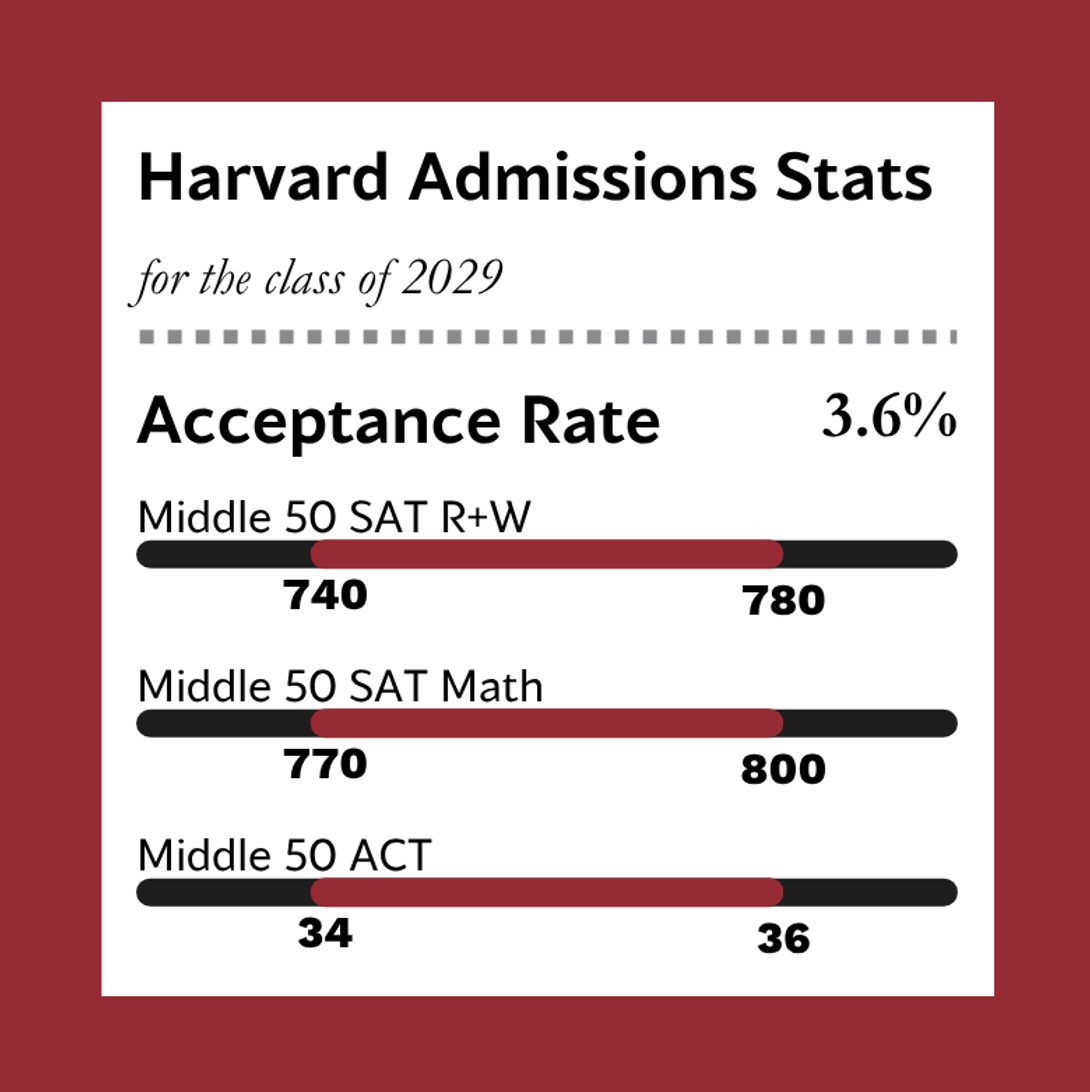
Let’s talk objective facts first: Harvard expects academic excellence from its applicants. We recently did a deep dive into last year's admissions statistics, which you can check out here. While we have some condensed info for you in this post, if you’re serious about Harvard and want to understand their academic standards in depth, we recommend you give it a read.
Last cycle, Harvard had a 3.6% acceptance rate, one of the lowest in the game. Based on their middle 50 data, we think it's fair to say that a 1550+ and/or a 35+ on your standardized tests are next to mandatory, and 94.61% of admitted students had a GPA above 3.75, with 70%+ of those having at least a perfect 4.0. Understanding these academic standards is crucial as you go forth on this journey.
| Test | 25th Percentile | 50th Percentile | 75th Percentile |
|---|---|---|---|
| SAT Reading | 740 | 760 | 780 |
| SAT Math | 770 | 790 | 800 |
| ACT Composite | 34 | 35 | 36 |
| ACT Math | 32 | 35 | 36 |
| ACT English | 35 | 35 | 36 |
| ACT Science | 33 | 35 | 36 |
| ACT Reading | 34 | 36 | 36 |
| GPA Range | Percent (all enrolled students) |
|---|---|
| 4.0+ | 72.41% |
| 3.75-3.99 | 22.20% |
| 3.5-3.74 | 4.11% |
| 3.25-3.49 | 0.60% |
| 3.0-3.24 | 0.17% |
| 2.5-2.99 | 0.34% |
| 2.0-2.49 | 0.17% |
However, grades and scores aren’t the only thing that makes someone a shoo-in for Harvard. Countless students have perfect GPAs and excellent scores, probably way more than there are open spots in all the Ivies combined. Robust extracurriculars are going to be more crucial than ever here, and students who build extensive, comprehensive, and focused activities are going to find a lot more success than other applicants.
What Does Harvard Really Want to See?
So, we know you need the best grades and scores possible, and we know you need good extracurriculars, but how do you actually build that kind of profile out? Once you meet their academic standards, you have to do a lot to differentiate yourself from everyone else who meets the academic standards. That’s why extracurriculars are so important.
Let’s discuss two students with identical grades and scores who are both applying to study biology:
Student 1:
Student council all four years of HS; currently student body president
Four-year varsity athlete in three sports; team captain
Member of a variety of service organizations at school; over 100 hrs of community service
Two years of science summer programs at Harvard; not specialized
Internship at a local business; not biology related
Works a paid summer job
Student 2:
Founded Bioethics Club at their HS
Conducted and published independent research on medical ethics
Volunteered at a hospital for two years
Interned at a medtech company
Participated in a bioethics summer pre-college program
Helps with family responsibilities
Obviously, both students are accomplished, but one stands out more to Harvard – and that’s student 2. While many of the things are solid about student 1, their activities don’t scream “I HAVE A PATH!!” Student 2, on the other hand, is not just interested in bio, but has found a niche in bioethics and has taken steps to pursue this interest outside of school.
How Does Harvard Decide Who Gets in?
When we said Harvard’s admissions policies are a black box, we mean it. There are very few resources out there that speak specifically to how they do it, but we know that admissions look similar across elite colleges. For a look into how decisions are made behind closed doors, take this video from Bloomberg, covering Amherst’s admissions committee.
It’s important to note that every college has a different set of institutional priorities, including Harvard. And those priorities can change from year to year, or even month to month! They might be inspired by internal policy changes or external policy directives from the government, or it could just be about what vibes they’re trying to curate.
What we do know about Harvard, though, is that they are looking for the best of the best. They want to see students who are "pointy,” and they don't necessarily care about well-roundedness. They want to see excellent grades, robust activities, and exceptional recommendation letters, but they also want to see students who are, for lack of a better word, kind of… normal? Not normal as in average, because Harvard doesn’t let average students in, but students who will bring good energy to their campus and defy the stereotype of what some people might think the traditional Harvard student would look like. That might look like working a paid job at the grocery store on weekends, having family responsibilities to attend to, or spending a lot of time on one community service action that actually gives back to your community.
How Can I Get into Harvard?
Besides grades and scores, depth matters so much throughout your application. Harvard doesn’t expect you to cure cancer at 17 years old, but they do want to see evidence that you care deeply about something and pursued it intentionally. That could be academic research, political organizing, filmmaking, robotics, creative writing, entrepreneurship, or countless other paths. The specific activity matters less than the level of commitment, initiative, and impact behind it.
And remember how we said Harvard is also trying to find “normal” students to let in? One of the ways we can tell that is by looking at their essay questions. Harvard’s supplemental essays are surprisingly open-ended. They don’t need to hear about your accomplishments or what clubs you joined; they’re trying to understand how you think, what matters to you, and what kind of person you’d be on campus. Harvard already knows you’re smart from your transcript. The essays are where they figure out whether you’re interesting.
That’s why one of the biggest mistakes applicants make is trying to sound “Harvard-worthy.” Students often become overly formal, robotic, or obsessed with proving how impressive they are. Ironically, that usually has the opposite effect. Harvard reads applications from some of the most accomplished students in the world every year. They don’t need more perfection! They want personality!
One thing we’ve seen consistently with successful Harvard applicants is that they rarely navigate this process entirely alone. The reality is that applying to a school this competitive often requires an enormous amount of long-term planning and strategic decision-making, especially when it comes to extracurricular development, summer opportunities, course selection, and essays. That’s one reason many families choose to work with a private college counselor. A strong counselor doesn’t “manufacture” a student or magically get someone into Harvard, but they can help students identify their strengths earlier, build a more cohesive application narrative, avoid common mistakes, and stay accountable throughout the process. At schools where thousands of applicants may have nearly identical grades and scores, the difference often comes down to how clearly and intentionally a student presents themselves, and having experienced guidance can make that process much more effective.
At the end of the day, there’s no magic formula for getting into Harvard. If there were, everyone would do it. But the strongest applicants usually have a few things in common: exceptional academics, a clear sense of direction, meaningful extracurricular depth, and essays that make them feel like a real person rather than a resume.
How Can TKG Help?
Students need guidance on how to strategically build an application that feels cohesive, intentional, and genuinely differentiated over the course of several years, because when your family goes it alone, it can feel daunting. Thankfully, that’s where we come in.
At The Koppelman Group, we work one-on-one with students to help them identify and develop the kinds of academic and extracurricular profiles highly selective colleges are actually looking for, and ones that genuinely interest them. That can mean helping a student refine a niche interest into a meaningful long-term “point,” identifying summer programs and research opportunities that actually fit with their resume, helping brainstorm clubs or initiatives for their school, and generally building an activities list that tells a clearer story about who they are and what they care about. Through this system, we help students move from something broad, like biology, to something more narrow, like bioethics, all while building a solid trail of evidence throughout the years.
We also help students navigate the parts of the application process that are often the hardest to do alone. That includes brainstorming and editing the Common App essay, developing supplemental essays that sound personal rather than overly polished, preparing for interviews, planning high school coursework, and making smart strategic decisions about testing and school lists. Throughout the process, our goal is never to turn students into a manufactured version of what we think Harvard wants. Instead, we help students present the strongest, clearest, and most compelling version of themselves possible.
Conclusion
Strategy matters so much early in high school. The students who tend to stand out aren’t randomly joining activities just to pad their resumes. Their application tells a story, showing that they’re building toward something over time, even if that story is still evolving.
Understanding what Harvard values can help you position yourself more effectively – not just for Harvard, but for other highly selective colleges as well. The goal isn’t to become a different person for admissions. It’s to present the strongest, clearest, and most intentional version of yourself possible.
Need help getting into a Top 20 school? Reach out to us today.