
Stanford attracts future engineers, filmmakers, entrepreneurs, neuroscientists, Olympic athletes, activists, writers, and people who aren't entirely sure what they want to do yet but are convinced they're going to do something interesting.
A lot of that comes from Silicon Valley's overt influence. Students arrive to find themselves surrounded by startups, venture capital firms, research labs, and some of the most ambitious people in the world. But reducing Stanford to technology or entrepreneurship misses a huge part of the picture. The university has spent decades cultivating a culture that rewards experimentation, and that culture shows up in their admissions process.
Stanford receives applications from tens of thousands of students who have already achieved remarkable things. Academic ability matters enormously, but it only explains part of why certain applicants rise to the top of the pile.
Who Actually Gets Into Stanford?
The academic profile of admitted Stanford students is about what most families would expect. Near-perfect grades and scores across the board, especially while taking the most rigorous high school classes available to them. Whether that means AP courses, IB classes, dual enrollment, advanced research opportunities, or some combination of all three depends on the school, but admissions officers expect students to challenge themselves academically whenever possible.
Overall admissions data for the Class of 2029:
| First-time, first-year applicants | Total |
|---|---|
| Applied | 57,326 |
| Admitted | 2,067 |
| Acceptance rate | 3.61% |
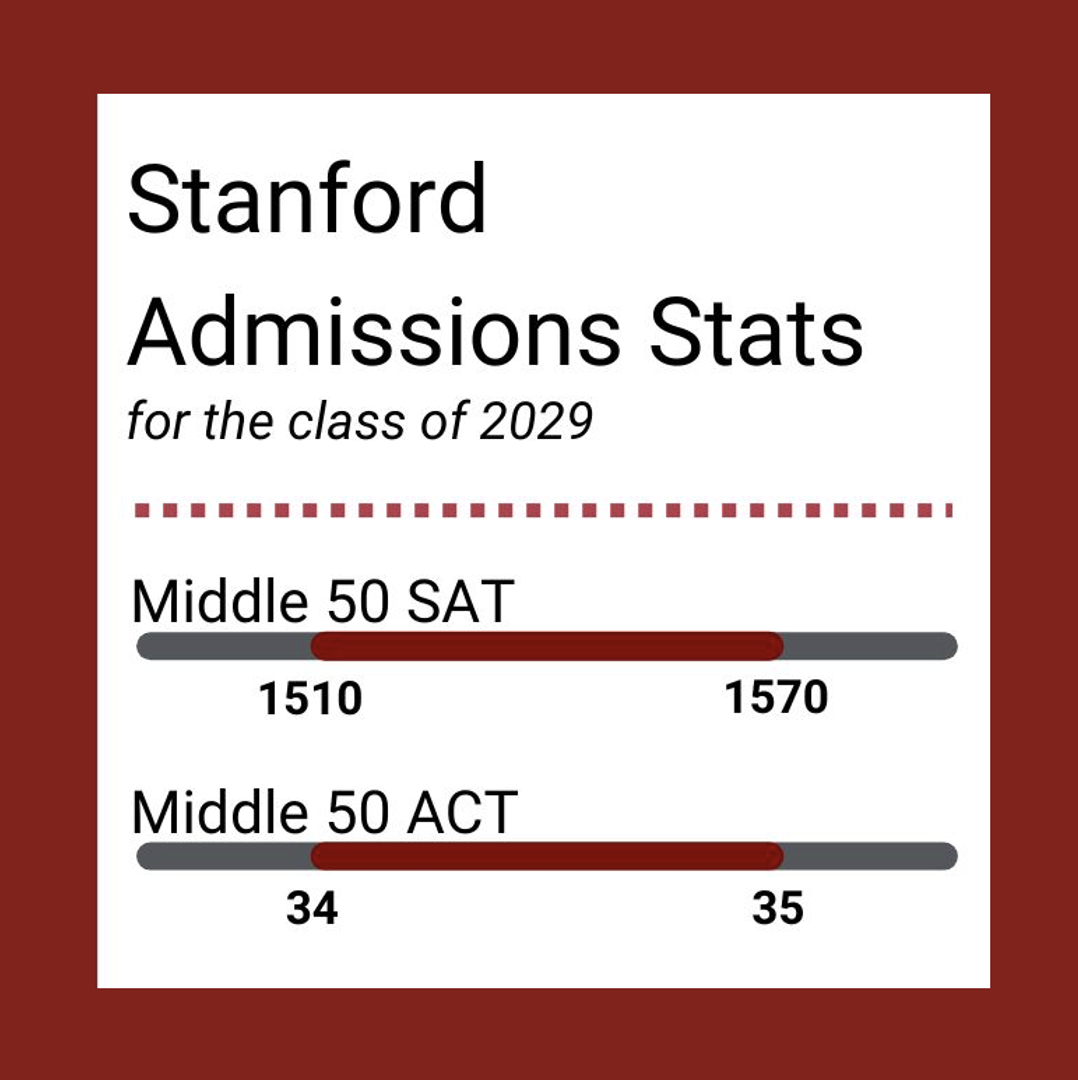
Testing remains important. While Stanford's policies have shifted over the years, admitted applicants are operating in extremely high ranges. Think SAT scores that frequently land in the 1500s and ACT scores clustered in the mid-30s. This is nonnegotiable for Stanford.
When so many applicants have as-close-to-perfect scores as possible, individual profiles become more important. Their admissions office reviews applications from students who have won national competitions, published research, launched organizations, and generally exhausted nearly every academic opportunity available to them.
Middle 50 testing data of admitted and enrolled first-time students:
| Test | 25th Percentile | 50th Percentile | 75th Percentile |
|---|---|---|---|
| SAT Composite | 1,510 | 1540 | 1570 |
| SAT Evidence-Based Reading + Writing | 740 | 760 | 780 |
| SAT Math | 770 | 790 | 800 |
| ACT Composite | 34 | 35 | 35 |
| ACT Math | 33 | 35 | 36 |
| ACT English | 35 | 35 | 36 |
| ACT Science | 33 | 35 | 36 |
| ACT Reading | 34 | 36 | 36 |
The students who perform best in the process have a noticeable pattern and momentum to their applications. It’s not just score/grade/resume stuffer collecting! Their accomplishments matter, duh, but they're a side effect of genuine engagement rather than the driving force.
Stanford's admissions office has repeatedly emphasized that it values intellectual vitality. That's a somewhat vague phrase, but in practice it usually refers to students who are energized by learning, curious about the world around them, and inclined to turn interests into action.
What Does Stanford Really Want to See?
Stanford wants to see that you care deeply about something, have goals, and have taken the steps to make them happen.
A student fascinated by climate science might spend years conducting research, organizing local sustainability initiatives, and building data projects around environmental issues. Somebody else may combine computer science, public policy, and education to create tools that help younger students access academic resources. It doesn’t necessarily matter what the topic is, but that you’ve actually dug into it.
We see this in successful Stanford applicants every year. They go out on their own to create things. Sometimes that's a research project. Sometimes it's a nonprofit. Sometimes it's a publication, a business, a community initiative, a creative endeavor, or an entirely new idea that didn't previously exist and we haven’t even thought of yet.
The admissions office wants students who take advantage of opportunities, or make them themselves.
How Does Stanford Decide Who Gets in?
Families often want admissions decisions to be clean and easy. We’d love that, too! They often think that if Stanford admits or denies a student with similar grades and scores, there must be one simple reason. Sometimes there is (cough grades and scores), but sometimes there isn’t. From Stanford:
“At Stanford, we practice holistic admission. This means that each piece in your application is reviewed as part of an integrated and comprehensive whole. We want to learn how you would grow, contribute, and thrive at Stanford. Academic excellence is the foundation of your application. Your preparation through challenging coursework and your potential to succeed are key factors in our contextual review.
Academic Excellence: The primary criterion for admission to Stanford is academic excellence, which means flawless or nearly flawless grades in rigorous courses. We expect you to challenge yourself throughout your educational journey and to do very well by maintaining a strong academic record.
Context: Just as no two Stanford students are the same, each applicant to Stanford is unique. This means that as we review your application, we pay careful attention to your unique circumstances. We take into account your background, educational pathway, and work and family responsibilities. By focusing on your achievements in context, we evaluate how you have excelled in your school environment and how you have taken advantage of what is available to you in your school and community.
Extracurricular Activities: Learning about your extracurricular activities and nonacademic interests helps us understand your potential contributions to the Stanford community. Students often assume our primary concern is the number of activities they participate in. In fact, an exceptional depth of experience in one or two activities may demonstrate your passion more than minimal participation in five or six clubs. You may also have work or family responsibilities. These are as important as any other extracurricular activity.
Intellectual Vitality: …Through your application, we hope to learn about your intellectual horizons. We want to hear about the ways you have expanded your perspective and sought new opportunities. We hope to envision how your energy, curiosity, and optimism would make a mark on Stanford and the world.”
As you can see, pretty in line with what we’re telling you.
For more insight into the process, there’s an old article from Stanford Magazine that explores how Stanford chooses their students: What It Takes. This article is from 2013, but it still covers a lot of the steps that go into how the decision is made in the room. Additionally, you can take a look at the non-academic factors Stanford considers to see what sways them beyond grades and scores:
| Nonacademic Factors | Very Important | Important | Considered | Not Considered |
|---|---|---|---|---|
| Interview | X | |||
| Extracurricular activities | X | |||
| Talent/ability | X | |||
| Character/personal qualities | X | |||
| First generation | X | |||
| Alumni/ae relation | X | |||
| Geographical residence | X | |||
| State residency | X | |||
| Religious affiliation/commitment | X | |||
| Volunteer work | X | |||
| Work experience | X | |||
| Level of applicant’s interest | X |
The admissions office is trying to build a cohesive, successful class. Stanford classrooms are demanding, and students need to demonstrate that they can thrive in that environment. Beyond academics, though, admissions officers are evaluating a much broader set of questions.
How does this student engage with their interests? What motivates them? What kinds of contributions are they likely to make on campus? How have they used the opportunities available to them? What perspectives might they bring into classrooms, residence halls, labs, performance spaces, and student organizations?
Context matters tremendously throughout this process. Part of the reason Stanford admissions can seem unpredictable is that the university is trying to create a community rather than assemble a ranking of applicants. Some students stand out because of their research, others because of artistic achievement, leadership, entrepreneurship, service, athletics, writing, or intellectual contributions that don't fit neatly into any category.
Reading successful applications, you frequently get the sense that the student is already exploring ideas, building things, creating opportunities, or pursuing questions that genuinely interest them.
How Can I Get into Stanford?
First, get excellent grades and scores. There is absolutely no way around this. Yes, one B+ will hurt you. Beyond that, it’s all about the story you’re telling with your application. Sorry, we know that’s vague!
GPA range of admitted and enrolled first-time students:
| GPA Range | Percentage |
|---|---|
| 4 | 73.30% |
| 3.75-3.99 | 16.50% |
| 3.5-3.74 | 6.70% |
| 3.25-3.49 | 3.00% |
| 3.0-3.24 | 0.30% |
| 2.5-2.99 | 0.30% |
Stanford students are unusually proactive, so you need to be, too. The university is filled with students pursuing independent research, launching projects, collaborating across disciplines, and taking advantage of resources that require initiative rather than simple participation. They want students who already demonstrate some version of that behavior before they arrive on campus.
This doesn't mean every applicant needs to found a company or create a nonprofit. Social media has done a remarkable (read: sarcasm) job convincing students that elite admissions requires increasingly elaborate accomplishments and a million extracurriculars that only prove you know how to join a club. But Stanford's admissions process is usually more nuanced than that; they want to see engagement. To requote what we already quoted, “...an exceptional depth of experience in one or two activities may demonstrate your passion more than minimal participation in five or six clubs.” See, they agree.
Stanford's essays also play a significant role in helping admissions officers understand who you are and what you’ve done, and their supplemental questions tend to reveal personality remarkably well. They ask a lot of questions, and they want to learn something new from each one. The strongest responses usually feel specific, reflective, and comfortable in their own voice. Students sometimes assume that writing for Stanford requires sounding oh-so-impressive, but in practice, we recommend the opposite approach. Admissions officers already know your resume; they want to see who you are.
How Can TKG Help?
One challenge families face with Stanford admissions is that the school values qualities that are difficult to manufacture quickly. Initiative, intellectual vitality, creativity, and genuine engagement develop over time, and they can’t emerge from a last-minute effort to "look Stanford." Starting early is your best bet to get into Stanford.
At The Koppelman Group, we spend a great deal of time helping students identify the interests that genuinely excite them and then finding meaningful ways to develop those interests throughout high school. We help students narrow a broad academic interest into a more focused niche and explore research opportunities, competitions, internships, independent projects, summer experiences, and leadership opportunities that deepen and prove those interests.
Many students have interesting interests but struggle to translate them into experiences that demonstrate growth and engagement, while others have done remarkable things but find it difficult to explain why those experiences mattered. Admissions officers only see what appears in the application, which means thoughtful presentation becomes almost as important as the experiences themselves. That’s where the right kind of help comes into play.
We also guide students through Common App essays, interview prep, and Stanford supplemental essays, but we also help with HS course planning, testing strategy, and college list development. Perhaps most importantly, we help students avoid building applications around assumptions. Stanford admissions is filled with applicants trying to reverse engineer what they think the university wants, which produces boring, bland, over-polished students. They don’t want that.
We aren’t trying to magically create a Stanford applicant, but rather help students understand their strengths, pursue opportunities thoughtfully, and communicate those experiences in a way that feels clear, compelling, and authentic – and developing those strengths can turn into a Stanford acceptance.
Conclusion
Stanford's admissions process reflects the culture of the university itself. The school values academic excellence, but it also wants students who are actively engaged with the world around them. That's part of what makes the process so competitive. Stanford receives applications from extraordinary students across every imaginable discipline. The admissions office is trying to understand how applicants think, what they care about, and how they might contribute to a campus filled with ambitious, creative, and deeply engaged people.
Understanding what Stanford wants won't eliminate the uncertainty that comes with highly selective admissions. It does, however, provide a clearer picture of what Stanford appears to value. And for applicants trying to make thoughtful decisions about how to spend their time during high school, that can help you strategize the right way.
Need help getting into a Top 20 school? Reach out to us today.