
MIT has a very specific reputation in the college admissions world. For some students, it’s basically the holy grail of STEM education. For others, it sounds vaguely terrifying – a place where everyone casually solves differential equations for fun while building satellites in their dorm room. And to be fair, there are definitely students at MIT who do that.
But one of the biggest misconceptions about MIT is that admissions is purely about raw intelligence or perfect math scores. Yes, of course, MIT expects extraordinary academic ability. Duh. But MIT is also looking for curiosity, initiative, creativity, collaboration, and a very particular kind of energy. They want students who genuinely like solving problems, building things, experimenting, tinkering, researching, and figuring out how the world works.
And importantly, MIT tends to value students who actually do things with their interests. Which is perfect, because building a strong, robust profile is exactly what we’re going to help you with today.
Who Actually Gets Into MIT?
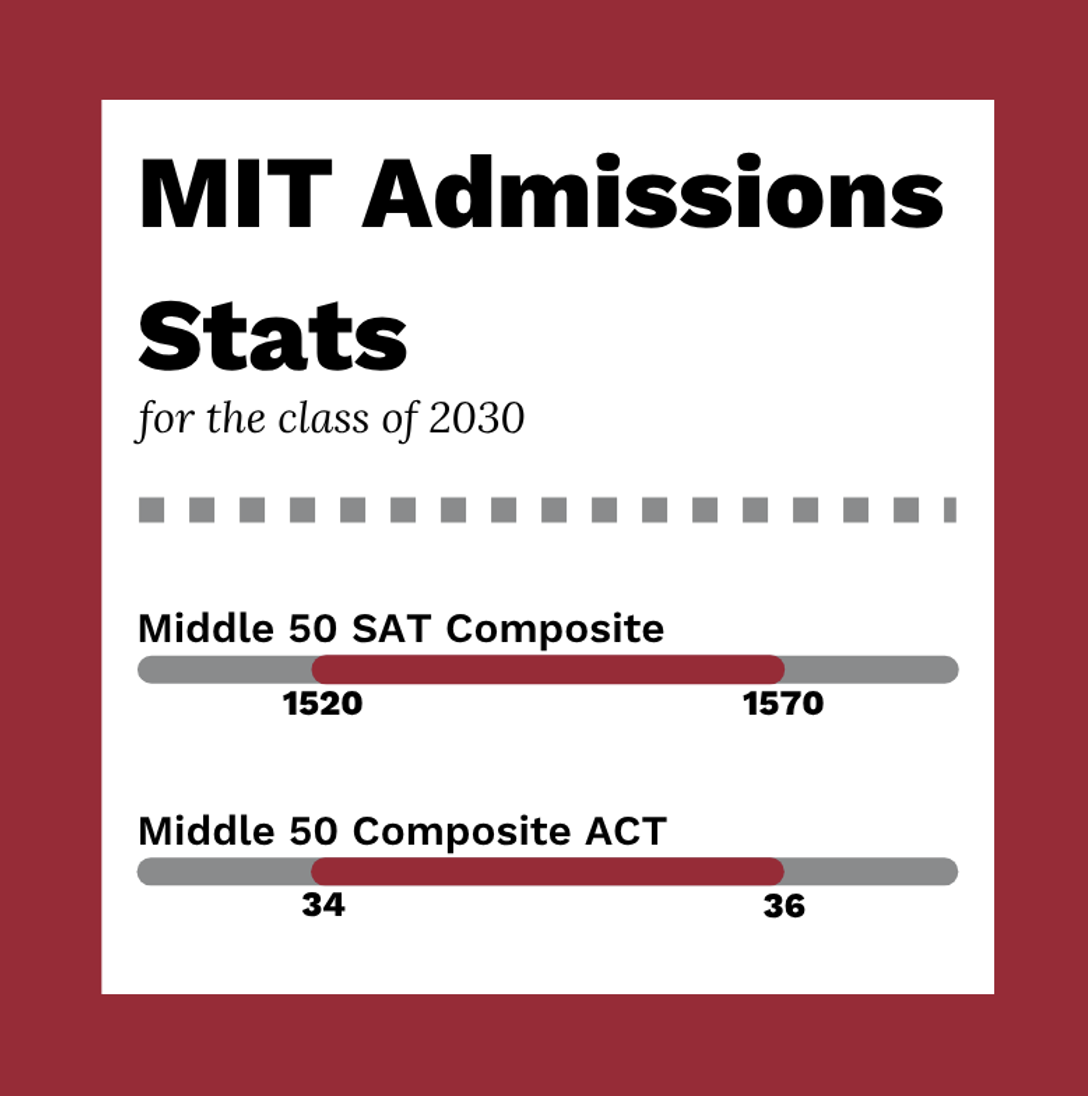
Let’s start with the reality check first: MIT admissions is brutally competitive. Every year, the school receives applications from thousands of students with near-perfect grades, elite test scores, advanced STEM coursework, research experience, and national-level accomplishments.
The academic bar is extremely high.
MIT’s published testing data tells the story pretty quickly. Students admitted to MIT generally score in the very top ranges nationally. SAT Math and ACT scores, in particular, are essentially operating at ceiling level for a huge portion of admitted students. Rigorous coursework is also non-negotiable. MIT wants to see students pushing themselves academically at the highest level available within their school environment.
| Test | 25th Percentile | 50th Percentile | 75th Percentile |
|---|---|---|---|
| SAT Composite | 1520 | 1550 | 1570 |
| SAT Evidence-Based Reading + Writing | 740 | 760 | 780 |
| SAT Math | 780 | 800 | 800 |
| ACT Composite | 34 | 35 | 36 |
| ACT Math | 35 | 35 | 36 |
| ACT English | 35 | 35 | 36 |
| Class Rank | Percentage |
|---|---|
| Top 10th of HS graduating class | 96% |
| Top Quarter of HS graduating class | 99% |
| Top Half of HS graduating class | 100% |
| Bottom Half of HS graduating class | 0% |
| Total submitting class rank | 30% |
However, high stats alone do not make someone an automatic admit. MIT rejects enormous numbers of applicants with perfect or near-perfect academic profiles every single year. Once you reach a certain threshold academically, admissions officers start evaluating something much more nuanced: how does this student think, engage, and apply their interests outside the classroom?
MIT tends to respond strongly to students who pursue intellectual interests beyond assigned schoolwork. Maybe that’s robotics research, open-source coding projects, engineering competitions, advanced independent math exploration, science communication, entrepreneurship, or experimental design work. MIT wants students who seem excited by ideas! They don’t want someone who just chases prestige for prestige’s sake.
What Does MIT Really Want to See?
A lot of students assume MIT is only looking for Olympiad winners, published researchers, or teenagers who founded biotech startups at age fifteen. Those applicants certainly exist, but MIT admissions wants a range of students.
MIT is not simply searching for the “smartest” applicants in some abstract sense – they are trying to identify students who actively use their intelligence in interesting, collaborative, and impactful ways. Let’s look at two hypothetical applicants interested in computer science.
Student 1 has a classic high-achieving STEM profile: coding club leadership, strong grades, AP Computer Science, math team, comp sci summer programs, volunteer tutoring, and a couple hackathons.
Student 2 became fascinated with accessibility technology after watching a family member struggle with mobility challenges. Over time, they began designing assistive software tools, teaching themselves programming languages outside school, collaborating with a local nonprofit, and building small prototypes that addressed real usability problems. They also documented the process publicly online and continued refining their projects through feedback and experimentation. This is in addition to similar activities as Student 1.
Shocker – MIT is much more likely to remember Student 2. They exhibit initiative, intellectual curiosity, problem-solving, and authentic engagement with technology in a way that feels real rather than strategically assembled. MIT also cares a surprising amount about interpersonal qualities. This is not a school trying to admit isolated academics, because collaboration matters enormously in MIT’s culture. Recommendation letters often play a major role because they help admissions officers understand how students contribute to classrooms, research teams, projects, and communities.
How Does MIT Decide Who Gets in?
MIT is trying to answer a specific question: how is this student likely to contribute to the MIT community? Academics are obvi important – MIT needs students who can handle an extremely rigorous curriculum. But once students clear that academic threshold, admissions officers begin evaluating a much broader set of qualities: creativity, initiative, resilience, collaboration, curiosity, and problem-solving ability.
MIT is very transparent about their process, and has tons of posts on their blog. They want you to read the posts. Here’s a note from The Room(s) Where It Happens:
“We spend just as much (or more) time reading applications and making decisions together. We run multiple committees simultaneously and hold several iterations of committee. We set ground rules that apply equally to our treatment of your application and to our treatment of one another, rooted in respect, kindness, and trust. We take over the bigger individual offices and pull in extra furniture to ensure everyone has a seat at the table. Some of us roll in the chairs from our cubicles to maximize our comfort during the long days and weeks, and the end of a round of committee precipitates a flurry of chairs rolling between offices. A typical day of committee involves spending 8-9 hours evaluating applications in the same room with the same people. Moving at a Non-Stop01 pace, the experience can be grueling. Personally, I love this part of our process. I love imagining the ~20,000! possible communities we might bring together. I love poring over applications with my coworkers, reconstructing your individual contexts and stories. I love hearing the perspectives my colleagues bring to the table – ways of seeing that might be unlike my own. I love how through discussion and consensus, we try to develop a collective understanding of living our mission and applying our values. I even love how we use moments of confusion or disagreement to grow together. It’s a very human process.”
MIT wants students who will contribute positively to collaborative environments, support peers, and participate actively in campus life. They want to build a community, not just assemble a spreadsheet of test scores.
Sometimes, the most compelling applicants are students who independently pursued projects because they genuinely wanted answers to questions that interested them. Sometimes it’s a student who taught themselves advanced concepts outside school. Sometimes it’s someone who combined technical interests with community impact, art, entrepreneurship, education, or advocacy in unusual ways.
Students occasionally assume they need to sound impossibly intellectual or hyper-technical throughout the entire application. That usually backfires. MIT admissions officers are reading thousands of applications from extremely smart students already. They are not looking for performances. They are looking for evidence of genuine engagement and potential. Plus, your personality matters here, too.
How Can I Get into MIT?
One of the biggest mistakes students make when applying to MIT is focusing too heavily on credentials instead of substance. Admissions officers are far less interested in whether you joined every STEM club available at your school than they are in whether you actually explored your interests deeply and independently. MIT applications become much stronger when they demonstrate initiative and sustained curiosity over time. You don’t need to conduct Nobel Prize-level research in high school.
But as we’ve explained, it does mean students should actively engage with the subjects they claim to love. A student interested in engineering might spend years designing personal projects, participating in robotics competitions, fixing machines, building prototypes, or experimenting with hardware outside class. A student interested in biology may independently pursue research, science communication, healthcare volunteering, or bioinformatics projects.
Your essays matter a lot here, too. MIT’s application questions are often deceptively simple (and relatively short in the college app game), but they reveal an enormous amount about how students think and interact with the world around them. Students who try too hard to sound impressive often end up sounding robotic, which is not what they want. MIT already knows you are academically capable through your stats, the essays show them you’re more than that.
It’s important to remember that applying to MIT usually requires years of intentional planning. The strongest applicants did not wake up during junior year and suddenly assemble an elite STEM profile overnight. Competitive applications come from consistent academic rigor, meaningful extracurricular depth, strong mentorship relationships, independent exploration, and strategic long-term development. A strong private college counselor can’t guarantee your admission to MIT’s next class, but they can help students identify opportunities, strengthen application narratives, and avoid common strategic mistakes.
How Can TKG Help?
At The Koppelman Group, we work closely with students to help them develop the kinds of academic and extracurricular profiles highly selective STEM schools actually respond to.
We help students identify authentic interests early and then build around them intentionally over time. That can mean refining a broad STEM interest into a more specific niche, pursuing meaningful research or engineering opportunities, developing independent projects, preparing for competitions, identifying strong summer programs, or brainstorming ways to apply technical interests in real-world settings.
We also guide students through the more nuanced parts of the admissions process that are difficult to navigate alone. That includes MIT supplemental essay brainstorming and editing, interview preparation, course selection strategy, testing plans, extracurricular positioning, and overall application narrative development. MIT applications are read holistically, which means every piece of the application needs to reinforce the broader picture of who a student is.
Most importantly, we never try to manufacture some artificial “MIT applicant” persona. In fact, that approach usually backfires. MIT admissions officers are extremely good at spotting students who feel like they’re trying to be MIT students instead of themselves. Our goal is to help students present themselves clearly, while also building applications that actually reflect the way they think, create, and engage with the world around them.
Conclusion
MIT is trying to build a community filled with students who are not only academically exceptional, but also deeply curious and collaborative.
The students who stand out are rarely the ones collecting disconnected achievements purely for appearances. More often, they are students whose interests evolved naturally into meaningful academic and extracurricular depth over time.
Still, understanding what MIT actually values can help students approach the process far more strategically. The goal is not to transform yourself into some fictional “perfect MIT-bound STEM super genius,” – it’s to build and communicate the strongest, clearest, and most intellectually engaged version of who you already are.
Need help getting into a Top 20 school? Reach out to us today.