
Dartmouth occupies a unique place in the Ivy League conversation. It’s incredibly prestigious, wildly selective, and academically intense, yet somehow still feels more personal and community-oriented than many of its peer schools. Dartmouth is not just looking for students who can survive rigorous academics. They are looking for students who will actively contribute to a tight-knit campus culture where people actually know each other, professors are accessible, and students are expected to engage both inside and outside the classroom.
In other words, Dartmouth admissions is not purely about numbers. If it were, the process would honestly be much simpler! So what actually separates students who get in from students who don’t? Let’s talk about it.
Who Actually Gets Into Dartmouth?
Let’s not beat around the bush – Dartmouth is one of the most academically competitive colleges in the country, with an acceptance rate of 5.4%. Competitive applicants are usually taking the most rigorous courses available at their high school while earning near-perfect grades. Standardized testing matters here too, and Dartmouth was one of the first schools to bring back mandatory testing post-COVID.
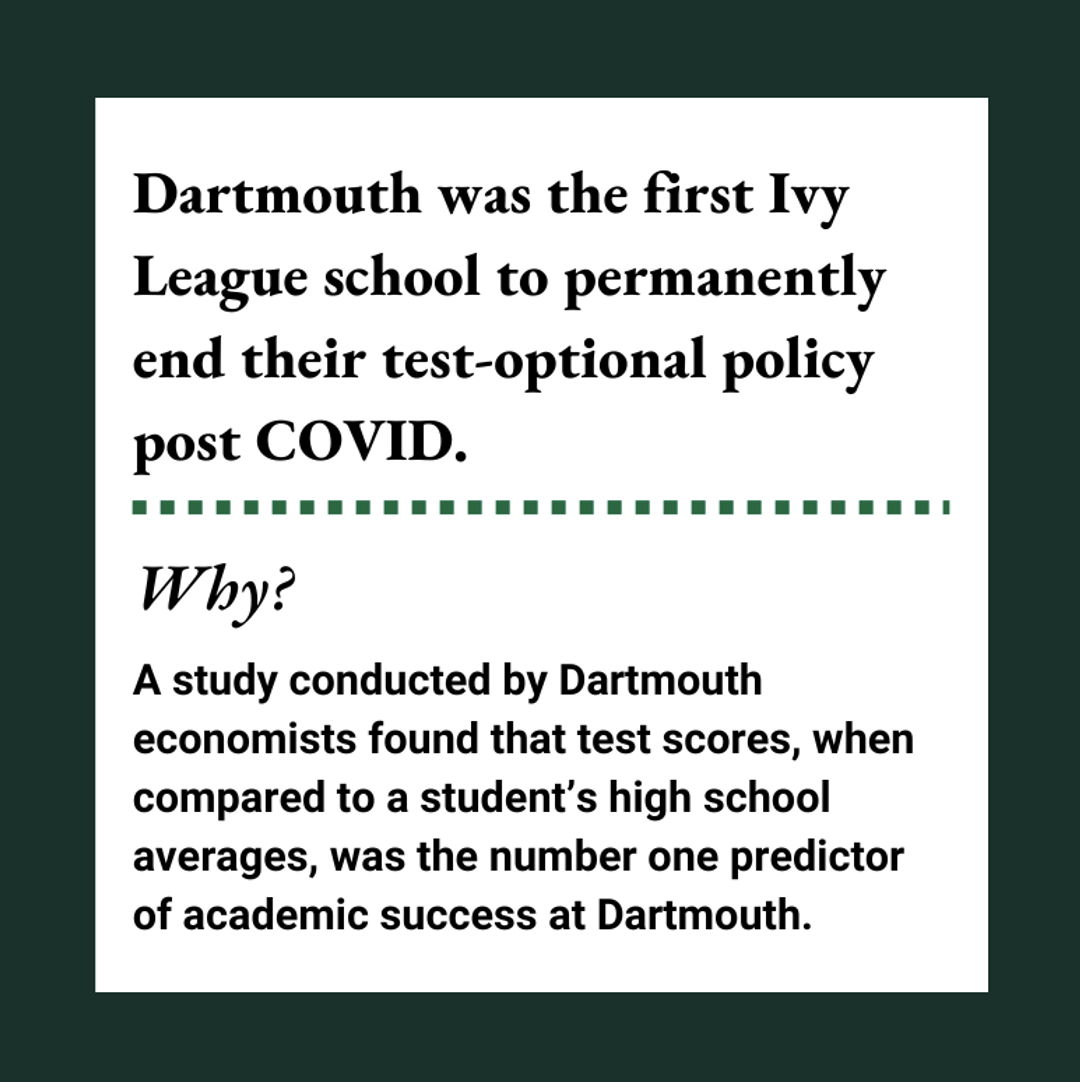
While admissions is holistic, Dartmouth applicants are generally operating in extremely high score ranges academically. Think 1500+ SAT territory and ACT scores in the mid-30s. And even those students are not guaranteed admission! While Dartmouth requires test scores, they don’t openly publish that data. Which is a bummer, but from experience, we know those ranges are that high.
Students often underestimate the process if their stats are high. Dartmouth receives applications from thousands of students who are already academically exceptional. By the time admissions officers begin reviewing files, strong grades and scores often serve more as baseline expectations than as differentiators.
| Class Rank | Percentage |
|---|---|
| Top tenth of HS graduating class | 93% |
| Top quarter of HS graduating class | 99% |
| Top half of HS graduating class | 100% |
| Percent reporting class rank | 44% |
What happens after the academic threshold is met? Dartmouth wants students who bring something identifiable to the table, whose applications feel cohesive, purposeful, and genuinely engaged with their interests. The strongest applicants are rarely the ones trying to do absolutely everything at once. More often, they’re students who pursued a smaller number of interests with unusual depth and consistency over time. They don’t want a jack of all trades – because they’re usually a master of none.
What Does Dartmouth Really Want to See?
One of the biggest mistakes applicants make with Dartmouth is assuming that because the school has a collaborative, outdoorsy, community-oriented reputation, admissions must somehow be “less intense” than other Ivies. Which is not even remotely true.
Dartmouth still wants extraordinary students. They just tend to prefer students whose accomplishments feel grounded in genuine engagement rather than pure resume engineering. To illustrate this, let’s look at a hypothetical.
Imagine two applicants applying as prospective poli sci majors. Both have near-perfect academics, strong testing, leadership positions, and rigorous coursework.
Student 1 has the classic “high-achieving everything” resume: student council leadership, Model UN, debate team, volunteer hours, multiple honor societies, varsity sports, generic summer programs, and a handful of scattered leadership titles. They have a 4.0 and killer test scores, and have a lot of in-school interests within politics and government, but didn’t go much further than that.
Student 2 has spent years deeply engaged with a single public policy issue area. They became interested in rural healthcare access after seeing challenges within their own community. That passion area led to independent research, organizing local awareness initiatives, interviewing local policymakers, volunteering with public health organizations, and eventually producing a podcast exploring healthcare inequities in underserved regions. They also have a 4.0 and the same ACT score as Student 1.
Student 2 is way more likely to get in. Dartmouth responds strongly to students who seem intellectually and personally invested in the work they’re doing. The activities feel connected to a larger passion rather than loosely connected school clubs.
And importantly, Dartmouth also pays attention to interpersonal qualities. Recommendation letters matter enormously here because the school values students who contribute positively to classrooms and communities, which is why it's the only Ivy League school to ask for a peer recommendation. They want students who collaborate well and who engage thoughtfully with academics and community.
How Does Dartmouth’s D-Plan Impact My Application?
One of the most distinctive parts of Dartmouth’s academic structure is the D-Plan, which shapes much of student life, and is an important part of the Dartmouth application.
The D-Plan allows students to essentially build portions of their own academic calendar around their goals and interests, and gives them carte blanche to conduct research or hands-on work tailored to their passions. .
For example, students can take off an off-cycle quarter to intern during periods when fewer college students are competing for positions. Others use the D-Plan to pursue international research, political campaign work, outdoor leadership programs, or independent projects during unconventional times of year. The structure encourages students to think proactively about how they want to use their college experience rather than simply moving through a fixed four-year schedule.
Dartmouth will ask you in their essays to talk about what you want to get out of your time there, and mentioning the D-Plan should be seen as mandatory. If the D-Plan doesn’t sound interesting to you, then Dartmouth might not be the best place for you.
How Does Dartmouth Decide Who Gets in?
Dartmouth is trying to assemble a class that feels dynamic, academically capable, collaborative, and genuinely engaged with the world around them. That’s a much messier process than people want it to be! For some insight into what they care about and how they decide, check out this video from Becky Munsterer, a former Dartmouth Admissions officer.
As you can see, Dartmouth wants students who can handle a rigorous liberal arts curriculum and contribute meaningfully in small classroom environments. But once an applicant clears that academic bar, admissions officers start asking broader questions. What perspective does this student bring? How do they engage with their community? Are they intellectually passive, or do they actively pursue opportunities beyond what was handed to them?
We’d also say that fit matters much more at Dartmouth than many applicants realize. Dartmouth has an unusually strong residential culture for an Ivy League school. Students are deeply involved on campus, traditions are a major part of student life, and the community is intentionally tight-knit. Admissions officers are evaluating whether that student seems likely to contribute positively to a highly engaged campus environment – they want students who make sense with the students who are already there.
Because of their culture, Dartmouth often responds well to students whose applications show substance and personality at the same time. Maybe that’s a student balancing advanced coursework with a part-time job. Maybe it’s someone deeply involved in a local community initiative instead of ten disconnected leadership titles. Maybe it’s an applicant whose teacher recommendations make it overwhelmingly clear that they elevate discussions and bring positive energy into a classroom.
How Can I Get into Dartmouth?
One of the smartest things a student can do when applying to Dartmouth is to stop thinking about the application as a collection of separate parts. Admissions officers are not reading your transcript, activities list, essays, and recommendations independently. They are reading all of it together and trying to understand one thing: who are you when all these pieces combine?
A student interested in environmental science might show that interest through coursework, research, outdoor leadership, local conservation work, or policy advocacy. A future history major might demonstrate curiosity through documentaries, archival projects, museum volunteering, writing, or independent reading. The specific activities matter less than the overall pattern. Dartmouth wants to see sustained engagement with what genuinely matters to you.
This becomes especially important in the essays. Dartmouth’s supplements tend to reward students who sound reflective, grounded, and self-aware rather than overly polished. Students sometimes assume Ivy League essays need to sound impossibly intellectual, and suddenly the writing becomes stiff and unreadable. That is not helping. The best Dartmouth essays usually feel thoughtful without trying too hard to prove how smart the writer is every other sentence. They want to get to know you and what you care about.
This is also why long-term planning matters so much. Successful applicants typically did not wake up halfway through their junior year and suddenly assemble a competitive Ivy League profile in six months. Their applications developed gradually through intentional academic choices, meaningful extracurricular involvement, strong relationships with teachers, and consistent exploration of their interests over time.
How Can TKG Help?
At The Koppelman Group, we help students develop applications that feel thoughtful, strategic, and genuinely personal. Because, despite what social media sometimes suggests, highly selective admissions success rarely comes from throwing random impressive-sounding activities at the wall and hoping something sticks.
We work one-on-one with students to identify authentic interests and help shape those interests into compelling long-term narratives throughout high school. That can involve refining broad academic interests into more focused areas of specialization, identifying meaningful summer programs or research opportunities, brainstorming independent initiatives, strengthening leadership development, or helping students build activity profiles that tell clearer, more intentional stories.
We also guide students through the parts of the process that are hardest to manage on their own: Common App essay brainstorming and editing, supplemental essay strategy, course selection, interview preparation, testing plans, and balanced college list development.
Most importantly, our goal is never to manufacture some fake “Dartmouth applicant” persona. That approach is usually obvious – and admissions officers see right through it. Instead, we help students present the strongest, clearest, and most genuine version of themselves possible.
Conclusion
Dartmouth admissions is competitive because Dartmouth is building an incredibly specific kind of campus community. The students who stand out at Dartmouth are rarely the ones joining every possible club for resume padding purposes. More often, they are students whose interests developed naturally over time into meaningful academic and extracurricular depth. Their applications feel cohesive because they actually reflect real curiosity and engagement.
Understanding what Dartmouth actually values can help you approach the process much more strategically. The goal is not to transform yourself into some imaginary “perfect Ivy applicant.” It’s to build and communicate the strongest, clearest, and most compelling version of who you already are.
Need help getting into a Top 20 school? Reach out to us today.