
A lot of students hear “UPenn” and immediately think one thing: Wharton. Finance bros. Pre-professional energy. Future consultants mysteriously appearing in Patagonia vests at age nineteen. And while some of those stereotypes exist for a reason, they also dramatically oversimplify what Penn actually is, because Penn is not just a business school attached to an Ivy League campus.
Penn is an academically intense, deeply interdisciplinary university that attracts students who are ambitious in a very specific way: they want to do things with their education. Penn students tend to be builders, organizers, researchers, founders, policy nerds, creatives, and yes, future bankers. Sometimes all at once! Penn is looking for students who are intellectually capable, obviously, but also students who seem energized by opportunity and likely to take initiative once they arrive on campus. Passive students do not usually thrive here – Penn likes momentum. So how can you build this kind of momentum? Let’s get into it.
Who Actually Gets Into Penn?
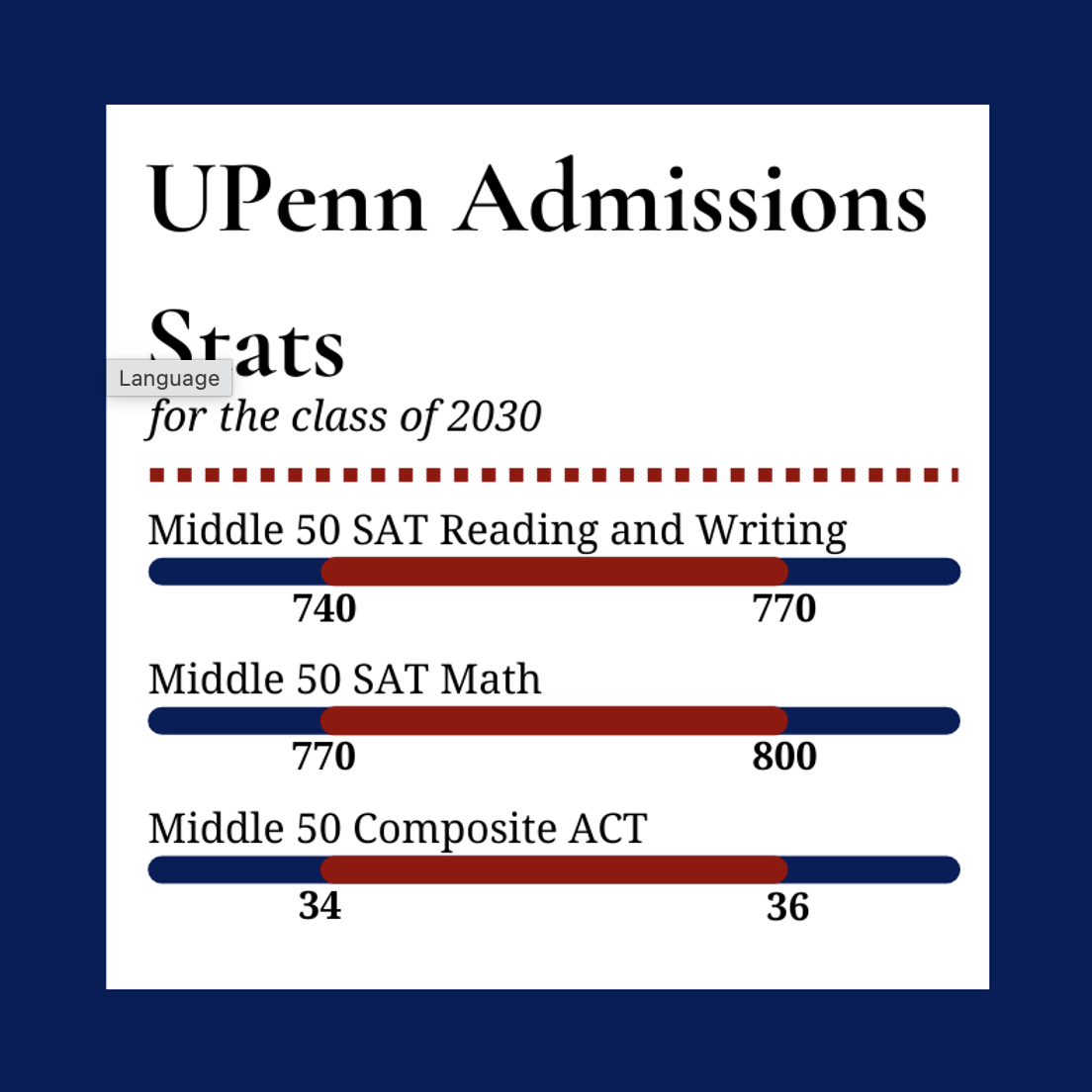
Penn is one of the most selective universities in the country, and the academic expectations reflect that immediately. Students admitted to Penn are typically near the very top of their graduating class while taking the hardest courses available to them. Strong testing matters too, especially in programs like Wharton, Engineering, or dual-degree options that attract intensely competitive applicant pools.
As you can see, Penn’s middle 50 data puts them at the very top of scores. That means excellence is the base standard. The same goes for their GPA data:
| GPA Range | Percentage |
|---|---|
| 4 | 59% |
| 3.75-3.99 | 31% |
| 3.5-3.74 | 5% |
| 3.25-3.49% | 5% |
| 3.0-3.24 | 0% |
| Average high school GPA of all degree-seeking, first-time, first-year (freshman) students who submitted GPA: | 3.9 |
|---|---|
| Percent of total first-time, first-year (freshman) students who submitted high school GPA: | 91% |
The average GPA for Penn enrollees is a 3.9, with over 91% of students submitting scores. While the 59% with a 4.0 might seem encouraging, that 31% probably leans more towards that 3.9 GPA.
A huge percentage of students applying already have elite grades and incredible test scores, but they also have rigorous coursework, strong extracurriculars, and a clear direction. Penn tends to respond particularly well to students whose applications feel directional and intentional. Purposeful, and even sometimes hyper-specific resumes, will stand out much more than a standard one. Students who clearly pursued opportunities connected to their interests rather than randomly accumulating activities for four years.
What Does Penn Really Want to See?
One of the biggest misconceptions about Penn is that admissions only values prestige-heavy accomplishments or business-oriented resumes. That’s not really true. Penn absolutely values ambition and achievement, but they also want students who genuinely care about the work they’re doing and have taken time to dive deep into their interests.
Let’s look at two hypothetical applicants applying to study economics in the School of Arts & Sciences.
Student 1 has the kind of resume students (and tbh, parents) think elite colleges want: DECA leadership, student government, varsity athletics, NHS, a selective summer business camp, volunteer hours, and several broad leadership positions across a smattering of school organizations. They’ve obviously tried to build something impressive and have worked hard, but it’s not distinguishing itself within Penn’s applicant pool.
Student 2 became fascinated by housing policy after seeing affordability issues impact their local community. That interest evolved into independent research on zoning laws, organizing local tenant-resource workshops, interviewing city officials for a student-run newsletter, and interning with a nonprofit focused on urban development. Along the way, they tied together economics, policy, and community advocacy into a very clear intellectual narrative. In addition to this niche-exploration, they also have a lot of the interests and activities the first student has (NHS, DECA, club presidency, etc.), but they went further than a summer program.
Penn is much more likely to remember Student 2. Student 2 pursued opportunities because they were genuinely interested in the topic, not because a school counselor, a parent, or a ChatGPT answer somewhere told them “leadership looks good.”
It’s also good to develop relationships with teachers, because recommendation letters matter a lot. They often reveal whether a student elevates classroom discussions, works well with peers, and actively engages with ideas rather than simply performing for grades.
How Does Penn Decide Who Gets in?
Penn admissions is “holistic,” but students sometimes misunderstand what that actually means. Holistic does not mean “anything can happen” or “grades don’t matter.” They absolutely do. It means Penn evaluates applicants across multiple dimensions at the same time rather than reducing decisions to one numerical threshold. In the case of Penn, and all Ivies, holistic means they’re looking for that Student 2 from above, and not Student 1.
Take a look at this video from Penn, discussing how they want you to navigate the college admissions process.
And of course, academics are foundational. Penn wants evidence that students can thrive in a rigorous environment where classes move quickly and expectations are high. But once students clear that academic threshold, admissions officers start evaluating something more nuanced. Does this student seem intellectually curious? Self-motivated? Engaged with opportunities around them? Do they appear likely to contribute meaningfully to Penn’s campus culture?
Penn admissions officers are reading applications within the environment available to each student. A student who maximized opportunities at a small public high school may be viewed just as favorably as someone from an elite prep school with vastly more resources. Penn is also trying to build a balanced class. Different academic programs have different needs, and institutional priorities shift year to year. Some applicants stand out through research, some through entrepreneurship, some through creative work, some through leadership, and others through community engagement or unusual interdisciplinary interests.
There is definitely a personality Penn seems attracted to, but they’re not looking for exactly one type of kid. However, there is a common thread: successful applicants are proactive. Their applications suggest movement, curiosity, and initiative rather than passive participation in pre-existing activities.
How Can I Get into Penn?
Penn admissions officers read thousands of applications filled with high test scores, AP classes, leadership positions, and summer programs. What actually stands out are applications where all the pieces reinforce each other and create a clear sense of direction.
A student interested in healthcare innovation might combine biology coursework, hospital volunteering, public health advocacy, independent research, and healthtech entrepreneurship initiatives into one broader narrative. A student interested in media might connect journalism, political communication, filmmaking, podcasting, and community storytelling projects together over several years. It doesn’t necessarily matter what you do, but rather that these things go together nicely.
Penn also places significant weight on essays, particularly because the supplements help reveal how students think. This is where students often become overly robotic. They assume they need to sound hyper-professional or impossibly accomplished, and suddenly the essays read like corporate press releases written by stressed-out teenagers. This goes not just for the supplements, but your Common App essay, too.
The strongest Penn essays tend to sound thoughtful, ambitious, and self-aware without feeling artificial. Penn wants students who are excited to engage deeply with the university’s resources and community, not students who simply want the Ivy League bumper sticker. One of their essays is to write a thank-you letter to an important adult in your life – they obviously want you to come into the process with some humility.
As we’ve discussed through this whole post, successful Penn applicants rarely build their profile overnight. Strong applications typically emerge from years of intentional course selection, in-depth involvement in extracurriculars, relationship-building with teachers and mentors, and strategic exploration of interests outside the classroom. A strong private college counselor cannot manufacture authenticity or guarantee admission, but experienced guidance can absolutely help students build a more cohesive application strategy over time.
How Can TKG Help?
At highly selective schools like Penn, strong applications rarely happen by accident. Most successful applicants did not suddenly “lock in” six months before deadlines and magically produce a compelling Ivy League profile overnight. At The Koppelman Group, we help students strategically develop applications that feel cohesive, differentiated, and authentic to who they actually are. Penn, in particular, tends to reward students whose applications demonstrate initiative, intellectual direction, and meaningful engagement beyond the classroom. We work with students to identify those strengths early and build around them thoughtfully throughout high school.
For some students, that means helping refine a broad interest into a more focused academic niche. For others, it means identifying research opportunities, internships, summer programs, entrepreneurial ventures, leadership initiatives, or independent projects that align naturally with their interests and long-term goals. We also help students think critically about how all the pieces of their application fit together, because Penn admissions officers are evaluating the overall narrative, not just isolated accomplishments.
Beyond extracurricular and academic strategy, we guide students through every major part of the admissions process: Common App essay brainstorming and editing, Penn supplemental essays, course selection, interview preparation, testing strategy, and college list development. Most importantly, we help students avoid one of the biggest mistakes in elite admissions: trying to manufacture a fake “perfect applicant” persona. Our goal is never to turn students into someone else. It’s to help them present the strongest, clearest, and most compelling version of themselves possible.
Conclusion
Penn admissions is competitive because Penn is building a class filled with students who are not only academically exceptional, but also proactive, intellectually engaged, and eager to take advantage of an unusually opportunity-rich environment.
The students who stand out are rarely the ones collecting disconnected resume lines purely for appearances. More often, they are students whose interests evolved naturally into deeper academic and extracurricular engagement over time. Their applications feel coherent because they reflect genuine curiosity and initiative.
Understanding what Penn actually values can help students approach the process far more strategically. The goal is not to transform yourself into a fictional “perfect Ivy League applicant.” It’s to build and communicate the strongest, clearest, and most authentic version of who you already are.
Need help getting into a Top 20 school? Reach out to us today.