
During the 2024–2025 admissions cycle, Northeastern University admitted only a very small fraction of its applicant pool, with an acceptance rate of 5.2%. That number can be jarring – especially for parents who remember when Northeastern was not that selective just a few years ago. But a headline percentage on its own doesn’t tell you much about how the school got here or what that selectivity actually reflects. Northeastern does release portions of its admissions data, but making sense of it requires a more thoughtful, layered breakdown. That’s exactly why we analyze these numbers every year: to help students understand the landscape clearly and build smarter, more grounded admissions strategies.
To do that, we rely on a familiar source: the Common Data Set (CDS). Most colleges and universities in the U.S. complete this standardized report so that organizations like U.S. News & World Report, the College Board, and Peterson’s can compare institutions using consistent data. The CDS covers a wide range of topics—many of them genuinely interesting—but for our purposes, we’re going to zero in on one specific portion of Northeastern’s 2024–2025 CDS: first-time, first-year admissions.
Trend Spotting: Five Years of Northeastern Admissions
Before we zoom in on this year’s numbers, it’s worth pulling back to understand the longer-term trend at Northeastern. Over the past several cycles, the university has seen application volume climb dramatically, while the proportion of students admitted has moved steadily in the opposite direction. Northeastern’s rise is shocking, but it probably has to do with them being both test-optional and not requiring any supplemental essays.
| Year | Total Applicants | Number of Admitted Students | Overall Acceptance Rate | ED Acceptance Rate |
|---|---|---|---|---|
| 2025 | 98,425 | 5,133 | 5.20% | 43.00% |
| 2024 | 96,631 | 5,459 | 5.60% | 38.70% |
| 2023 | 91,000 | 6,191 | 6.80% | 32.90% |
| 2022 | 75,244 | 13,829 | 18.40% | 51.20% |
| 2021 | 64,459 | 13,199 | 20.50% | 37.70% |
*Denotes our own calculation based on the raw numbers
Key Takeaways for Trend Data:
ED acceptance rates are sort of all over the place, but they seem to value it
The shift to test-optional policies coincided with a significant surge in applications following the 2020–2021 cycle, and removing supplements only brought that number up
The result? An applicant pool that is both massive and intensely competitive. Clearing Northeastern’s academic bar is necessary, but it’s only the starting line. At this level, differentiation is what actually moves the needle, which can be hard when you don’t have supplemental essays to write.
C1: First-Time, First-Year Admission, Applications
Here’s the breakdown for first-time, first-year applicants during the 2024-2025 cycle:
| First-time, First-year Applicants | Total | Admitted | Acceptance Rate | Enrolled | Yield Rate |
|---|---|---|---|---|---|
| Men | 42,678 | 2,058 | 4.80% | 1,089 | 52.80% |
| Women | 55,719 | 3,074 | 5.50% | 1,667 | 54.20% |
| Total | 98,425 | 5,133 | 5% | 2,759 | 53.80% |
*Denotes our own calculation based on the raw numbers
| First-time, first-year applicants | Total | In-state | Out-of-state | International | Unknown |
|---|---|---|---|---|---|
| Applied | 98,425 | 12,304 | 67,424 | 17,616 | 1,081 |
| Percent of total applicant pool | 100% | 12.50% | 68.50% | 17.90% | 1.10% |
| Admitted | 5,133 | 1,332 | 3,076 | 671 | 54 |
| Acceptance Rate | 5.20% | 10.80% | 4.60% | 3.80% | 4.90% |
| Enrolled | 2,759 | 737 | 1,703 | 270 | 49 |
| Yield Rate* | 53.80% | 55.30% | 55.40% | 40.20% | 90.70% |
*Denotes our own calculation based on the raw numbers
Key Takeaways for Acceptance Rates:
An acceptance rate hovering around the low single digits makes Northeastern a reach for virtually every applicant
Northeastern’s yield remains lower than many peer schools with similar acceptance rates
Application interest skews female, but they don’t have a lower acceptance rate
There’s no sugarcoating it: Northeastern is brutally competitive. If you’re reading this, you already know that. But vague awareness isn’t enough. Real strategy depends on understanding the numbers behind the reputation – who gets in, how they get in, and what the admitted class actually looks like.
Early Decision
Applying Early Decision to Northeastern has historically come with a higher admit rate than Regular Decision, though that advantage has compressed as more students have caught on. Seeing a bigger percentage can make ED feel like a cheat code – and it’s definitely not. But, we do like the ED numbers we’re seeing.
| Number of ED applications | 3,466 |
|---|---|
| Percent of applicants applying ED | 4% |
| Number of ED acceptances | 1,492 |
| ED acceptance rate | 43.00% |
| Percent of admitted students accepted through ED* | 29.10% |
*Denotes our own calculation based on the raw numbers
Why This Matters: Northeastern’s ED admit rate is meaningfully higher than its overall acceptance rate. While ED doesn’t override weaknesses in an application, it can provide a real edge for students who already present as strong fits.
Like most selective schools, Northeastern is dealing with simple math: more applicants chasing a fixed number of seats. Roughly a third of Northeastern’s incoming class is drawn from the ED pool – and since Northeastern doesn’t publish the EA numbers, we we don’t know how many more come from there.
Regular Decision
Northeastern doesn’t publish a clean RD acceptance rate, but we can estimate it by backing ED admits out of the total pool. These figures aren’t perfect, especially since we can’t see EA numbers (and we assume they’re high), but they’re at least a good rule of thumb.
| Number of RD applications* | 94,959 |
|---|---|
| Number of RD acceptances* | 3,641 |
| RD acceptance rate* | 3.80% |
| Percent of admitted students accepted through RD* | 70.90% |
*Denotes our own calculation based on the raw numbers
Why This Matters: The majority of Northeastern’s class ultimately comes from Regular Decision, but RD is far more selective than ED. If Northeastern is your clear first choice and your application is already competitive, applying Early Decision is often the strongest strategic move available.
Waitlist
Unfortunately, Northeastern does not give us any waitlist stats:When schools don’t give us waitlist data, it can leave students feeling confused and lost. We wish they’d publish this, but what do we know. We’re just experts!
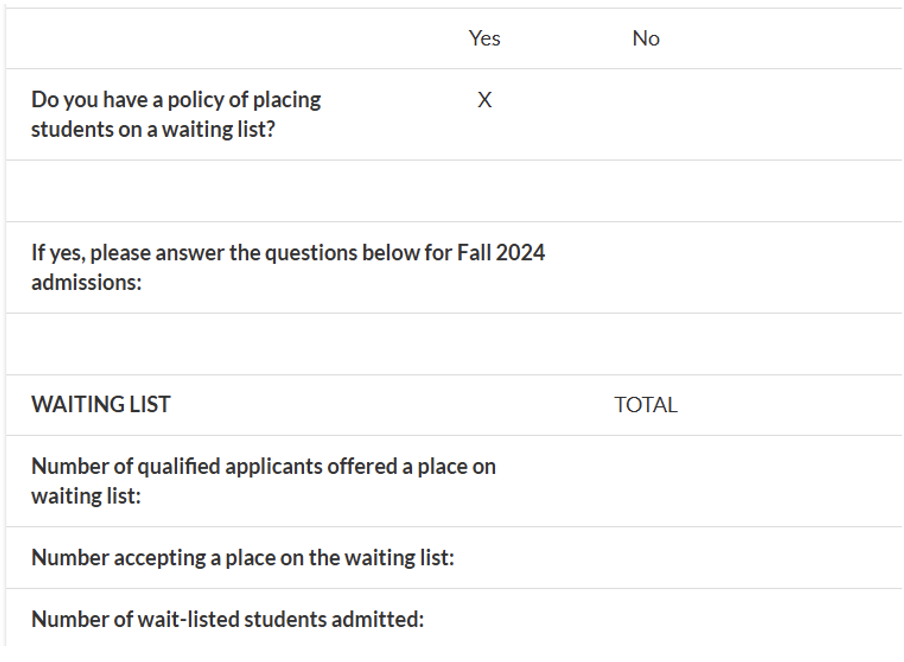
What we will say is that when a waitlist decision lands, student reactions usually fall at opposite ends of the spectrum. Some assume it’s a soft rejection, while others convince themselves it’s basically an acceptance, and neither is accurate. A waitlist at Northeastern means the admissions office thinks you’re great! They just don’t have space right now. Even without transparency, we help students navigate Northeastern’s waitlist (and others like it) every single year.
C9-C2: First-Time, First-Year Profile, or Scores and Grades
Northeastern continues to offer a test-optional pathway, but that policy should not be mistaken for a lack of academic scrutiny. Across higher education, schools are taking a harder look at how students perform once they arrive on campus, and many have found that applicants admitted without scores tend to struggle at higher rates. That realization has already prompted several institutions to reinstate testing requirements. Northeastern hasn’t made that shift, and we don’t think they ever will, but submitting strong scores can still work strongly in your favor.
Even when testing isn’t required, the numbers tell a very clear story. Examining how many students opt to report scores, and how high those scores are, gives us meaningful insight into what Northeastern expects academically.
Breakdown of enrolled students who submitted test scores:
*Denotes our own calculation based on the raw numbers
| Percent | Number | |
|---|---|---|
| Submitting SAT Scores | 24% | 653 |
| Submitting ACT Scores | 7% | 203 |
| Total Submitting Scores* | 31% | 856 |
Why This Matters: Roughly 31% of enrolled students submitted standardized test scores, not many at all. Since Northeastern doesn’t require scores or supplements, they’ve seen a boost in admissions numbers.
Now, let’s take a look at the score breakdowns for each section of the ACT and SAT:
| Test | 25th Percentile | 50th Percentile | 75th Percentile |
|---|---|---|---|
| SAT Composite | 1450 | 1490 | 1520 |
| SAT Evidence-Based Reading + Writing | 710 | 730 | 760 |
| SAT Math | 730 | 760 | 780 |
| ACT Composite | 33 | 34 | 35 |
| ACT Math | 30 | 33 | 35 |
| ACT English | 33 | 35 | 35 |
| ACT Science | 31 | 33 | 35 |
| ACT Reading | 33 | 35 | 36 |
Why This Matters: With middle-50% ranges around 1450-1520 on the SAT and 33–35 on the ACT, we generally recommend aiming for at least a 1500 or 34 to be competitive
First-time, first-year students with scores in each range:
| Score Range | SAT Evidence-Based Reading + Writing | SAT Math |
|---|---|---|
| 700-800 | 82% | 92.34% |
| 600-699 | 18% | 7.20% |
| 500-599 | 0% | 0.46% |
| 400-499 | 0.00% | 0.10% |
| Score Range | SAT Composite |
|---|---|
| 1400-1600 | 93.72% |
| 1200-1399 | 6.13% |
| 1000-1199 | 0.15% |
| Score Range | ACT Composite | ACT English | ACT Math | ACT Reading | ACT Science |
|---|---|---|---|---|---|
| 30-36 | 99.01% | 95% | 79.80% | 97.04% | 93.60% |
| 24-29 | 0.99% | 5.42% | 19.70% | 2.96% | 6.40% |
| 18-23 | 0% | 0.00% | 0.49% | 0% | 0% |
Standardized Test Score Takeaways:
The typical enrolled Northeastern student reports SAT or ACT scores at the very top of the national range
Because these statistics reflect enrolled students rather than all admits, it’s likely that many students who chose other schools had even stronger results
Submitting a score below roughly a 1400 SAT or 30 ACT can significantly hurt competitiveness
While a tiny fraction of students fall below these ranges, those cases are not a realistic model for admissions strategy
To be a credible contender at Northeastern, your academic profile needs to be extremely strong. Even scores that land you in the highest national percentiles may place you toward the lower edge of Northeastern’s admitted pool. The same principle applies to grades and class rank as well.
| GPA Range | Percentage |
|---|---|
| 4 | 86.77% |
| 3.75 - 3.99 | 7.65% |
| 3.5 - 3.74 | 3.95% |
| 3.25 - 3.49 | 0.80% |
| 3.0 - 3.24 | 0.65% |
| 2.5 - 2.99 | 0.18% |
Key GPA Takeaways:
GPAs meaningfully below the top of the scale weaken an application, even though the overall range may look forgiving on paper
Applicants reporting GPAs under roughly 3.75 represent true anomalies, and you shouldn’t base your strategy on being an exception
| Class Rank | Percentage |
|---|---|
| Top 10th of HS graduating class | 68.80% |
| Top Quarter of HS graduating class | 94.00% |
| Top Half of HS graduating class | 99.80% |
| Bottom Half of HS graduating class | 0.20% |
| Total submitting class rank | 21.90% |
Key Class Rank Takeaways:
Most enrolled students finish high school in the top quarter of their graduating class
Many colleges don’t require rank to be submitted, and many high schools don’t share it either
As rank drops, admission odds decline sharply
Before anyone gets too excited, let’s reset expectations. The very small number of admitted students showing ACT scores in the low 20s, or GPAs under 3.5 are not evidence of flexible standards. Those cases are exceptions, and they are not an invitation to think, “Great, so I still have a shot!” We don’t know who those students are or what factors influenced their outcomes. Some may be recruited athletes; others could be first-generation students, applicants from under-resourced schools, refugees, or individuals with extraordinary circumstances. You cannot build a strategy around trying to become an outlier.
TL;DR: If you want your strongest possible shot at Northeastern, near-perfect grades and the highest scores you can reasonably earn are the baseline.
Considerations
This is where the Common Data Set stops feeling clean and starts getting subjective. Yes, Northeastern evaluates concrete academic factors like GPA, course rigor, and standardized, but those are only the foundation. On top of that sits a set of qualitative “considerations” that don’t come with a rubric and can’t be engineered perfectly. This gray area is where strategy matters most. Let’s start with academics:
| Academic Factors | Very Important | Important | Considered | Not Considered |
|---|---|---|---|---|
| Rigor of secondary school record | X | |||
| Class rank | X | |||
| Academic GPA | X | |||
| Standardized test scores | X | |||
| Application Essay | X | |||
| Recommendation(s) | X |
Key Takeaways for Academic Factors:
As a school with no supplements, it doesn’t surprise us that the essay isn’t too important to them
Many high schools don’t report class rank, so its absence isn’t inherently negative
Strong performance in the most rigorous courses available to you is essential
| Nonacademic Factors | Very Important | Important | Considered | Not Considered |
|---|---|---|---|---|
| Interview | X | |||
| Extracurricular activities | X | |||
| Talent/ability | X | |||
| Character/personal qualities | X | |||
| First generation | X | |||
| Alumni/ae relation | X | |||
| Geographical residence | X | |||
| State residency | X | |||
| Religious affiliation/commitment | X | |||
| Volunteer work | X | |||
| Work experience | X | |||
| Level of applicant’s interest | X |
Key Takeaways for Nonacademic Factors:
Northeastern does track demonstrated interest
Qualities like talent, character, and personal attributes are inherently subjective
You can’t control legacy status, first-generation background, or geography – but you can control how you spend your time and what you pursue outside the classroom
Some nonacademic factors are straightforward. Where you live or whether you have alumni connections are fixed details, not levers you can pull – so don’t obsess over them. Others, like curiosity, creativity, or character, are far more interpretive. Admissions officers piece these together by reading your application holistically: essays, recommendations, activity choices, and overall voice. There’s no formula here, but fit with Northeastern absolutely matters. It’s worth asking yourself honestly whether the school’s culture, priorities, and experiential focus truly align with what you want before going all in.
Demonstrated interest is tracked, and thankfully, that’s something we can control. Going on school tours, virtual or IRL, reading newsletters, emailing your AO, etc., are all things you can do to rack up those points.
Extracurriculars are doing far more than just being “important” at Northeastern. How you spend your time outside of class is one of the clearest (and only) ways to distinguish yourself in a pool full of qualified applicants and no supplemental essays. Competitive students aren’t stacking random clubs or chasing leadership titles for optics. They’re investing deeply in a small number of pursuits that clearly connect to their academic interests and long-term direction. Depth, focus, and intentionality stand out – and helping students build those kinds of profiles is exactly what we do year after year.
Conclusion
Northeastern is highly selective. No duh, we know. But hopefully you leave this post having a clearer, more concrete understanding of what that selectivity actually looks like when you’re assessing your own competitiveness and planning your strategy.
That said, admissions can’t be solved with a spreadsheet alone. Data reveals trends and thresholds, but it doesn’t fully capture what Northeastern values as a community, and it certainly doesn’t tell your story. When we work with students, whether they’re applying Early Decision, Regular Decision, or navigating more complex pathways, our approach is never exactly the same. Strategy starts with the individual: how you think, what motivates you, where you’ve invested your time, and where you’re headed. There’s no single formula for getting into Northeastern – and the students who earn admission don’t all look the same on paper.
One way to increase your odds? Working with college consultants who are experts in the field and have a high rate of success getting students into Northeastern. We help countless students gain admission to top universities every single year – reach out to us today to get started.